
From Lab to Village: A One Health Blueprint for Resilient Communities
About This Series: This case study is part of a GLC4HSR and ACCESS Health International series, ‘Resilience in Action ’, unpacking presentations from the GLC4HSR Annual Conclave 2026 for a wider audience. It is designed to bridge the gap between technical policy discussions and actionable health systems insights.
About the Presenter: This document is based on a presentation by Professor Utpal Tatu, Professor & Chairman, Department of Biochemistry, Indian Institute of Science.
Context
What does pandemic preparedness look like when viewed not from a national command centre, but from a village? In Prof. Utpal Tatu’s work, resilience is built by connecting the health of people, animals, and the environment at the local level, turning One Health from a powerful idea into a practical operating model for India.
Introduction
Pandemics are rarely born inside hospitals. They are born much earlier: in the water that flows past a village, in the animals that share space with families, in the build-up of resistance inside bacteria that no one has yet noticed. By the time a disease enters a primary health centre, the system is already responding to something that began upstream.
There is ample conversation on why pandemic preparedness cannot begin only at the point of outbreak. It has to begin in the "normal" years, in the unglamorous spaces where human, animal, and environmental health intersect every single day. Resilience, in other words, is local before it is national. It is built before it is needed.
The One Health Village Model, developed and championed by Prof. Utpal Tatu of the Indian Institute of Science, is built precisely on this insight. It argues that One Health becomes real only when silos are connected on the ground, in the very villages where India's risks first emerge. As Prof. Tatu puts it: "In the end of the day, you really have to work at the ground level, how each one of us can make a difference at our levels: that's really the message."
The challenge: when scale and silos collide
India’s public health challenge is not just one of population size. It is also one of fragmentation. Rural and peri-urban realities are shaped by close contact between people, livestock, stray animals, local water systems, and informal ecosystems of care. Yet the institutions meant to respond to these realities often operate in parallel rather than in partnership. Primary health centres focus on human patients. Veterinary systems focus on animals. Environmental contamination is tracked separately, if at all. The result is a set of disconnected silos in a context that is, by nature, deeply interconnected.
Prof. Tatu’s presentation makes the point plainly: if India’s health risks are interconnected, then its preparedness systems must be as well. Local outbreaks, zoonotic risks, antimicrobial resistance, and water-related contamination do not respect bureaucratic boundaries. They emerge through interaction. Any resilience model that fails to account for those interactions is likely to remain reactive rather than preventive.
This is what makes the One Health lens so valuable in the Indian context. It does not merely add another layer to the health system. It asks a more fundamental question:
What if preparedness were designed around the actual ecology of risk?
From laboratory science to community action
One of the most compelling aspects of this case is that it does not emerge from abstract advocacy. It emerges from a scientific career rooted in rigorous research. Prof. Tatu describes his journey as that of a researcher who, over time, moved from laboratory science toward deeper community-facing engagement. He frames this not as a rejection of science, but as its fulfillment. Sophisticated tools, he suggests, achieve their highest value when they are brought out into the community.
Prof. Utpal Tatu has spent his career at the Indian Institute of Science working on infectious diseases, neglected pathogens, rabies, and the human-animal interface. His laboratory was the first to identify multidrug-resistant Candida auris in a way that became an internationally referenced genome sequence. His team was part of India's national sewage surveillance initiative. During COVID-19, his lab developed an RT-PCR diagnostic kit that received approval from ICMR. And significantly, his team had been detecting coronaviruses in animals as early as 2015, years before the pandemic.
That scientific grounding strengthens the case study in an important way. It shows that resilience is not being romanticized as community action alone. Rather, this is an effort to translate advanced science into field-ready public health architecture - one that is local in execution and ambitious in design.
The One Health Model Village: a practical unit of change
At the center of the case is a concept that is both deceptively simple and radical: take one village and treat it as the operating unit of resilience.
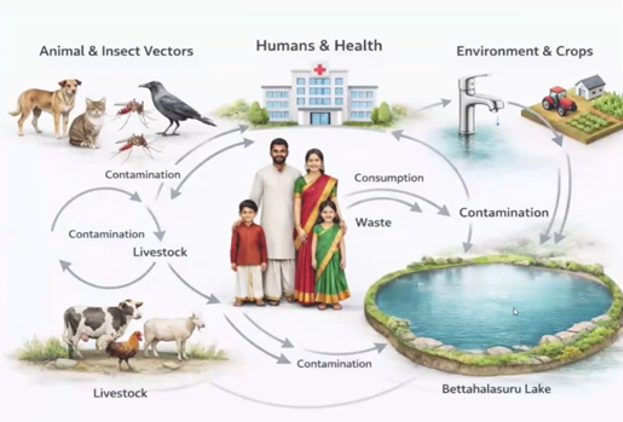
The original model village, Bettahalusuru, located in southern India, was chosen because it carries (in compressed forms) the hallmarks of the country itself. Inside its boundaries sit a poultry farm, a piggery, a natural water body that supplies the community, a primary health centre, and a veterinary hospital. Each of these elements exists in thousands of Indian villages. What is missing almost everywhere is the connection between them.
This is why the village was discerned the right scale for intervention. It is small enough to map completely, large enough to contain the full ecology of risk, and concrete enough to act on every day.
To see the model clearly, it helps to picture four streams of information flowing through the same village and finally meeting.
- Human health is captured through the primary health centre, where community members already present with illness, infection, and exposure.
- Animal health is tracked through the veterinary hospital, animal health camps, and the small-scale animal industries that surround the village - the piggery, the poultry farm, and informal husbandry.
- Environmental health is monitored through the natural water bodies, sewage outlets, and the contaminants moving through them.
- And cutting across all of these is a layer of risk intelligence: antimicrobial resistance data, zoonotic signals, vector-borne disease indicators, and the use of pesticides in nearby agriculture.
Here, the integration is built around existing pillars within the village, which is why it is referred to as a One Health Model Village. It links AMR data, sewage water contaminants in local water bodies used by the community, health issues reported at the primary health centre, and problems emerging from small-scale animal husbandry.
The mechanics are intentionally unspectacular. Nothing entirely new is being built. What is new is the wiring. Information that previously sat in separate offices, in separate registers, in separate institutions, now begins to be read together. That is what turns a village into a sentinel.
Spotlight: One Water
The strength of the model lies in what it connects. Of all the streams running through the model, water is the one that makes it most legible to communities, to policymakers, and to a wider audience.
It is a One Health, One Water project that examines how the condition and recycling of local water bodies affect water quality, and in turn how water quality influences animal health, animal husbandry, and human health. The relevant data is drawn from both the primary health centre and the veterinary centre. Inside the village, the One Water project looks closely at the body of water that supplies the community: the sewage outlets that feed into it, the recycling patterns around it, and the contaminants that accumulate within it. It then traces the consequences forward, into the animals that drink that water, the livestock that depend on it, and the human households that ultimately rely on it for daily life.
It allows systems to see upstream causes rather than only downstream consequences.
Water, in this framing, is not an environmental footnote. It is a shared medium of risk. A single contaminated water body is simultaneously an animal health issue, a human health issue, and an antimicrobial resistance issue. Spotlighting water makes One Health intuitive and gives communities a tangible point of entry into a concept that can otherwise feel abstract.
Preparedness before the pandemic: the value of proactive surveillance
Because this presentation was delivered in the context of pandemic preparedness, response, and recovery, one of its most significant contributions is its emphasis on proactivity.
The One Health Village Model contributes to pandemic preparedness in three concrete ways.
- First, it is proactive rather than reactive. Most preparedness investments arrive after a crisis has revealed a gap. This model goes earlier, into the surveillance of animals, water, and AMR, before any single outbreak makes such monitoring fashionable. Prof. Tatu's own pre-pandemic work is illustrative: his lab was detecting coronaviruses in animals as early as 2015. Works that looked niche at the time and proved foundational when COVID-19 arrived.
- Second, it generates early warning signals from the right places. Most novel pathogens of pandemic potential are zoonotic. By integrating animal health data, environmental data, and human data inside the same observational frame, the village model creates the conditions in which an unusual signal, a cluster of animal illnesses, a shift in water quality, or an unexpected pattern at the PHC can be detected before it becomes a national emergency.
- Third, it builds response agility through local data integration. When information already flows across human, animal, and environmental systems in peacetime, the same channels can be activated quickly during a crisis.
Preparedness, in this sense, does not necessitate a separate plan. It is the everyday capacity of a community to see its own risks clearly. That is what makes this model a pandemic preparedness asset, not a One Health demonstration project.
From dashboard to digital twin
An especially forward-looking element of the initiative is the effort to build dashboards that may eventually evolve into a digital twin of village health dynamics. The team has built a dashboard that aggregates fragmented data from the village's human, animal, and environmental streams. The longer-term ambition is even more promising; to evolve that dashboard into a digital twin of the village itself: a living, data-driven fingerprint of how its health systems behave over time. The early version is already operational.
This matters because it changes what village-level work is capable of. Local interventions have historically been criticised as anecdotal, difficult to compare, and hard to scale. A digital twin reframes that limitation. A village can now be modelled, monitored, and learned from, and the patterns that emerge from one village can be tested against another. Resilience here goes beyond boots-on-ground to evolve into data that serves institutional memory.
It is also a testimony to science’s applications: that the same sophistication used in molecular research can be brought to bear on a village water body, a piggery, and a primary health centre and made useful at that scale.
Scaling the Method
The clearest sign that the One Health Village Model is more than a single intervention is that it is already moving.
Within India, the team is extending the model to additional villages in Karnataka, Gujarat, Maharashtra, and Goa. Internationally, partnerships are being built with universities in Nepal, with the Friendship Foundation in Bangladesh, and with Makerere University in Uganda. Prof. Tatu also represents South Asia at the One Sustainable Health Foundation in Paris, anchoring the model in a wider global ecosystem.
The framing is intentionally structural: the aim is to scale this approach across India, since national-level solutions alone cannot address the problem, regardless of the extent of government support. The focus, therefore, is on breaking it down to the village level. It captures the philosophy of the model. Scale is not achieved by going bigger. It is achieved by going smaller, repeatedly, and well. A village is replicable/adaptable in a way that a national programme is not. The conditions for adaptation are modest: an existing PHC, an existing veterinary system, a recognisable water body, an animal industry of some kind, and a willingness to connect what already exists. Almost every Indian village meets that description.
This is what gives the model its South-South relevance. It does not export an Indian system; it offers an Indian method.
What resilience in action really means here
The One Health Village offers a timely and compelling reminder that resilience is not only about recovery after disruption. It is about the systems we build before disruption arrives. One Health becomes a method for redesigning preparedness through villages, water systems, animal surveillance, local institutions, and data integration.
The enduring value of this case lies in its clarity. In a country of immense scale, centralized action will always be necessary, but it will never be sufficient on its own. Durable resilience requires local intelligence, local integration, and local ownership. By bringing laboratory science into community systems and creating a model that can be replicated across settings, this work points toward a more practical, more preventive, and more connected future for health security in India.
That is why this is not simply a case for rallying around One Health. It is a story about how resilience goes from abstraction to definition.